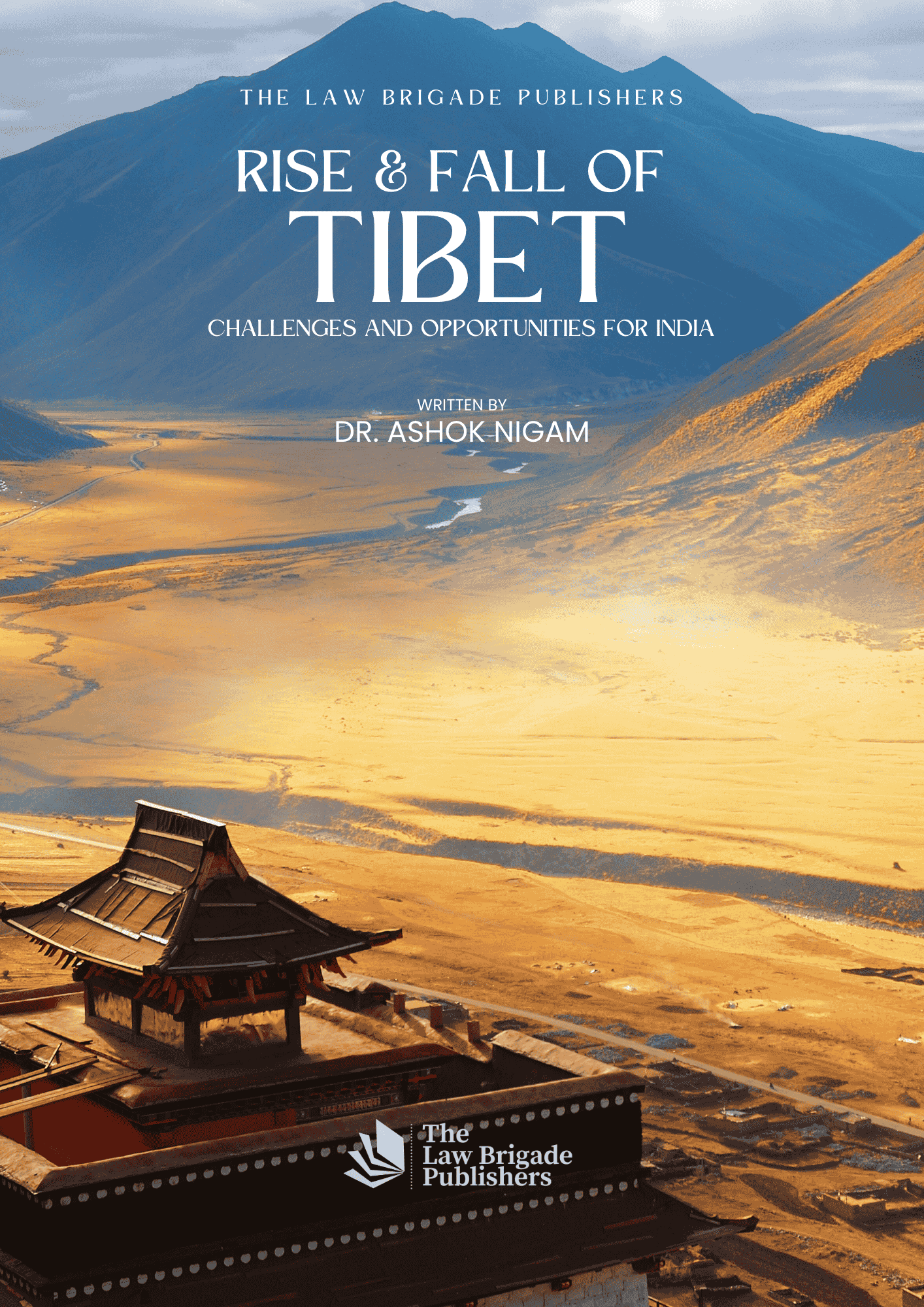
Rise & Fall of Tibet
Challenges and Opportunities for India
Authors
Publication Statistics
Synopsis
Rise & Fall of Tibet: Challenges and Opportunities for India presents a deeply researched and historically grounded analysis of Tibet’s political, strategic, and civilizational trajectory, with particular emphasis on its enduring relevance to India’s national security, foreign policy, and regional diplomacy. Drawing upon extensive historical records, treaties, diplomatic correspondences, and geopolitical developments, the book situates Tibet at the crossroads of Asian power politics involving India, China, Nepal, and external imperial forces.
The work traces Tibet’s evolution from an autonomous Himalayan buffer state shaped by Buddhism, trade, and trans-Himalayan cultural exchanges, to its gradual subordination under Chinese imperial influence and eventual loss of political autonomy. It meticulously examines the triangular relationships between Tibet, Nepal, and India, and later the decisive interventions of British colonial power and Qing China, highlighting how Tibet became a focal point of strategic rivalry. The narrative further explores the complex interplay of religion, commerce, diplomacy, and military power, including the role of the Dalai Lama institution, Sino-Tibetan relations, Nepal–Tibet conflicts, and British forward policy culminating in the Younghusband expedition.
Beyond historical reconstruction, the book critically evaluates the long-term consequences of Tibet’s decline for India. It analyzes how the disappearance of Tibet as a buffer fundamentally altered India’s northern frontier, intensified Sino-Indian tensions, and continues to shape border disputes, security calculations, and regional geopolitics. At the same time, the study identifies opportunities for India—diplomatic, cultural, and strategic—arising from Tibet’s historical legacy, its people, and its global significance.
By integrating history with strategic analysis, Rise & Fall of Tibet offers scholars, policymakers, and strategic thinkers a nuanced understanding of Tibet not merely as a historical entity, but as a continuing factor in India’s geopolitical challenges and opportunities in the 21st century.
References
- [1] Government of India. Indo-Nepal Treaty of Peace and Friendship. New Delhi, 1950.
- [2] Government of India; People’s Republic of China. Agreement on Trade and Intercourse Between Tibet Region of China and India (Panchsheel Agreement). Beijing/New Delhi, 1954.
- [3] Government of Great Britain; Qing Government of China. Anglo-Chinese Convention on Tibet. London, 1906.
- [4] Government of Great Britain; Government of Russia. Anglo-Russian Convention Respecting Tibet. St. Petersburg, 1907.
- [5] Government of China; Government of British India. Anglo-Chinese Tibet Trade Regulations. Beijing/Calcutta, 1908.
- [6] Tibetan Government. Complaint to the United Nations Concerning the Invasion of Tibet. Lhasa/New York, 1950.
- [7] Government of India. Ministry of External Affairs Annual Reports. New Delhi, 1950–1956.
- [8] Government of India. Parliamentary Debates (Lok Sabha and Rajya Sabha). New Delhi, 1949–1954.
- [9] Government of India, Intelligence Bureau. Confidential Reports on Tibet and Himalayan Frontiers. New Delhi, 1950–1951.
- [10] Government of India. Report of the North and North-Eastern Border Defence Committee (Himmat Singh Committee). New Delhi, 1951.
- [11] Thorat, S. P. Security Assessment of Nepal and Himalayan Borders. Government of India Report. New Delhi, 1951.
- [12] British Foreign Office. Correspondence Relating to Tibet and China. London: HMSO, early 20th century.
- [13] Curzon, George Nathaniel. Speeches and Statements on British Frontier Policy. London, n.d.
- [14] Younghusband, Francis. India and Tibet. London: John Murray, 1910.
- [15] Bogle, George. Journals and Correspondence of the Tibet Mission. British East India Company Records, 1774–1775.
- [16] People’s Daily (Renmin Ribao). Official Statements on Tibet. Beijing, 1950.
- [17] Zhou, Enlai. Statements on Tibet and Chinese Frontier Policy. Beijing, 1950–1954.
- [18] Ministry of Foreign Affairs, People’s Republic of China. Diplomatic Notes to the Government of India. Beijing/New Delhi, 1950.
- [19] Government of Nepal. Official Communications with India and Tibet. Kathmandu, 1950–1954.
- [20] Nepali Congress. Party Resolutions and Political Statements. Kathmandu, 1950–1956.
- [21] The Hindu. Editorials on Tibet and Nepal. Madras, 1950–1955.
- [22] The Statesman. Editorial Commentary on Himalayan Geopolitics. Calcutta, 1950–1954.
- [23] The Pioneer. Political Editorials on Nepal and India. Allahabad, 1950s.
- [24] Nehru, Jawaharlal. Speeches and Writings, 1947–1954. New Delhi: Government of India Publications.
- [25] Dalai Lama XIV (Tenzin Gyatso). Statements and Accounts on the Chinese Occupation of Tibet. Lhasa/India, 1950–1951.
- [26] Norbu, Thubten Jigme. Personal Accounts of Sino-Tibetan Negotiations. India, mid-20th century.
- [27] Singh, K. I. Personal Interview with the Author. Kathmandu, July 1969.
- [28] Bell, Charles Alfred. Tibet: Past and Present. Oxford: Clarendon Press, 1924.
- [29] Lamb, Alastair. The McMahon Line: A Study in the Relations Between India, China and Tibet. London, 1966.
- [30] Maxwell, Neville. India’s China War. London: Jonathan Cape, 1970.
- [31] Fisher, Margaret W.; Rose, Leo E.; Huttenback, Robert A. Himalayan Battleground: Sino-Indian Rivalry in Ladakh. London, 1963.
- [32] United Nations. Documents on the Question of Tibet. New York, 1950–1951.
- [33] Government of India. Colombo Plan Reports. New Delhi, 1950–1960.
How to Cite
License
License Terms for Inkbound Publishing
Ownership and Licensing:
Authors of monographs submitted to Inkbound Publishing retain the copyright of their work while granting the press specific rights. Authors maintain ownership of the copyright and grant Inkbound Publishing the right of first publication. Simultaneously, authors agree to license their monographs under the Creative Commons Attribution-ShareAlike 4.0 International (CC BY-SA 4.0) License.
License Permissions:
Under the CC BY-SA 4.0 License, others are permitted to share and adapt the work, even for commercial purposes, provided that appropriate attribution is given to the authors, a link to the license is provided, and acknowledgment is made of the initial publication by Inkbound Publishing. New works adapted from the original must be licensed under the same CC BY-SA 4.0 terms. This license encourages the broad dissemination and reuse of scholarly monographs while ensuring that the original work is properly credited and that derivative works remain equally open.
Additional Distribution Arrangements:
Authors are free to enter into separate, non-exclusive contractual arrangements for distributing the published version of the work (e.g., posting it to institutional repositories, personal websites, or including chapters in other publications), provided that the original publication by Inkbound Publishing is acknowledged.
Online Posting:
Authors are encouraged to share their work online (e.g., in institutional repositories, on personal websites, or on academic networking platforms) both prior to submission (such as preprints) and after publication. This practice can facilitate productive exchanges, increase the visibility and impact of the work, and enhance citations.
Responsibility and Liability:
Authors are responsible for ensuring that their submitted monographs do not infringe on the copyright, privacy, or other rights of third parties. Inkbound Publishing disclaims any liability for any copyright infringement or violation of third-party rights within the submitted monographs.
For any questions regarding these License Terms, please contact us at editor@inkbound.org.